

A conference can have excellent speakers, strong content, and an impressive venue, but the attendee experience can still suffer if people cannot hear the presentation, slides are difficult to see, lighting feels flat, microphones fail, or transitions between sessions become confusing.
That is why event production services for conferences should be treated as a core part of conference planning rather than equipment ordered shortly before the event.
Professional conference production connects sound, video, staging, lighting, presentations, technical crews, show control, rehearsals, recording, streaming, and backup systems into one coordinated production plan.
This guide explains what conference production normally includes, how the main technical elements work together, what affects the budget, when planning should start, and what corporate event managers should check before appointing a production partner.
Quick Answer: What Are Event Production Services for Conferences?
Event production services for conferences cover the technical and operational systems required to deliver presentations, speeches, panel discussions, videos, awards, entertainment, livestreams, and other conference content professionally.
A typical production scope may include:
- Audio systems
- Wireless and lectern microphones
- LED screens and projection
- Presentation management
- Stage design and construction
- Lighting
- Speaker confidence monitors
- Video playback
- Cameras
- Recording
- Livestreaming
- Technical crew
- Show calling
- Rehearsals
- Rigging
- Power distribution
- Internet requirements
- Backup equipment
- On-site technical support
The correct setup depends on the event format, room size, delegate numbers, agenda, venue infrastructure, speakers, branding, recording requirements, and budget.
For events involving a wider operational scope, production should be coordinated with the overall corporate event planning process rather than handled as an isolated technical task.
Why Conference Event Production Matters
Conference production is often most noticeable when something goes wrong.
A microphone that cuts out during the CEO’s opening speech can distract the audience immediately. A presentation displayed in the wrong format can delay a session. Poor stage lighting can affect both the live audience and event photography. Incorrectly positioned screens can make content difficult to read from the back of the room.
Good production should feel almost invisible.
The audience should be able to focus on the speakers and content without thinking about microphones, screens, lighting cues, presentation laptops, cameras, or technical transitions.
Professional event production supports several important conference goals.
Clear Communication
Speeches, presentations, videos, panel discussions, and Q&A sessions must be easy to hear and understand throughout the venue.
Professional Brand Presentation
The stage, screens, lighting, graphics, signage, and presentation templates should create one consistent visual experience.
Smooth Session Transitions
A conference may include keynote speeches, panels, videos, interviews, awards, networking breaks, entertainment, and breakout sessions. Technical teams help these elements move from one to another without unnecessary delays.
Speaker Confidence
Presenters perform better when microphones, slides, countdown timers, confidence monitors, clickers, videos, and stage movements have been tested before they walk on stage.
Risk Reduction
Testing, backups, communication systems, technical rehearsals, and clear responsibilities reduce the likelihood that one technical problem will interrupt the entire program.
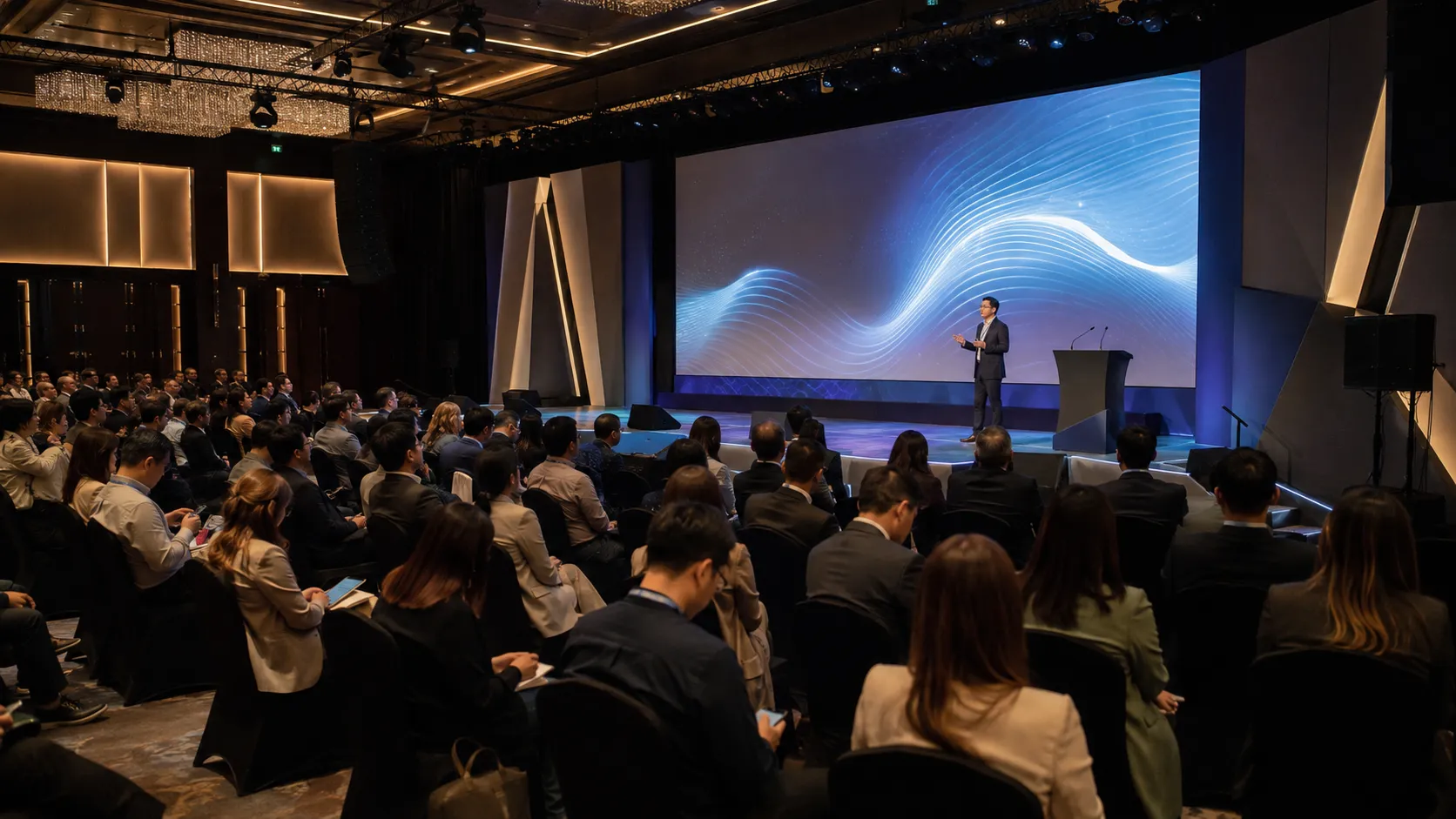
What Do Event Production Services for Conferences Include?
The production scope can range from a simple meeting room with microphones and presentation screens to a multi-room international conference with LED walls, broadcast cameras, livestreaming, interpretation, custom staging, and complex show control.
The following areas should normally be reviewed during production planning.
01. Conference AV and Sound Systems
Conference AV begins with understanding what the audience needs to hear.
Audio requirements depend on:
- Room size
- Room shape
- Ceiling height
- Audience capacity
- Seating layout
- Number of speakers
- Panel discussions
- Audience Q&A
- Entertainment
- Breakout rooms
- Recording requirements
- Livestreaming
A small leadership meeting may need only a few microphones and room speakers.
A large conference may require a complete sound system with multiple wireless microphones, stage monitors, digital mixing, audience microphones, playback channels, backup units, and dedicated audio technicians.
Microphones
Common options include:
- Handheld wireless microphones
- Lavalier microphones
- Headset microphones
- Lectern microphones
- Panel microphones
- Audience Q&A microphones
The microphone type should match how each speaker will present.
For example, a keynote speaker who moves across the stage may benefit from a headset or lavalier microphone, while a moderator managing audience questions may require handheld microphones supported by event staff.
Sound Checks
Every important microphone, playback source, presentation video, walk-in music track, and entertainment input should be tested before delegates enter.
Do not assume that equipment is ready simply because it worked at another event.
Room acoustics, stage positioning, guest numbers, furniture, and venue infrastructure can all affect the final setup.
02. Screens, LED Walls, Projection, and Video
Visual content has become central to modern conferences.
Delegates may need to see:
- Presentation slides
- Speaker videos
- Product demonstrations
- Data
- Remote participants
- Sponsor content
- Social media feeds
- Event branding
- Live camera feeds
- Polling results
- Timers
- Award graphics
The production team should determine whether the conference requires projection, televisions, LED screens, or a combination of different display systems.
Screen Size and Position
The largest screen is not automatically the best solution.
The correct screen setup depends on:
- Audience viewing distance
- Room dimensions
- Stage width
- Ceiling height
- Content format
- Seating layout
- Camera positions
- Venue restrictions
For wide conference rooms, additional relay screens may be required so delegates sitting away from the central stage still have a clear view.
LED Screens
LED walls can provide a strong visual backdrop and allow flexible layouts for presentations, branding, videos, camera feeds, and sponsor content.
However, the decision should consider installation access, available space, rigging, power, stage design, viewing distance, venue regulations, and budget.
Projection
Projection can remain practical for many conference environments, especially where suitable screens and controlled lighting conditions are available.
The production company should assess brightness, screen size, projector placement, sightlines, and room lighting before recommending the system.
03. Presentation Management
One of the most underestimated parts of conference production is presentation management.
Imagine receiving slides from 20 speakers in different formats just before their sessions begin.
One presenter brings a PowerPoint file.
Another needs a video embedded in the slides.
Another wants to present directly from a personal laptop.
Another makes final changes five minutes before going on stage.
Without a defined process, presentation changes can quickly create delays.
A Better Presentation Workflow
A professional conference production plan should establish:
- A presentation submission deadline
- An approved slide format
- A central presentation management computer
- File naming conventions
- Video testing
- Font and compatibility checks
- Final speaker approval
- Backup copies
- A clear process for late changes
For larger conferences, organizers may create a speaker-ready room where presentations can be reviewed before being transferred to the main production system.
This allows speakers to make final checks without interrupting the live conference environment.
04. Conference Staging
The stage is the physical centre of most conferences.
It influences visibility, speaker movement, branding, photography, video, accessibility, and the overall impression of the event.
Conference staging may include:
- Stage platforms
- Steps
- Ramps
- Lecterns
- Panel furniture
- Scenic backgrounds
- LED structures
- Branded panels
- Speaker monitors
- Confidence screens
- Decorative elements
The design should support the program rather than compete with it.
Stage Size
Stage dimensions should consider:
- Number of people appearing at once
- Keynote presentations
- Panel discussions
- Awards
- Product demonstrations
- Entertainment
- Camera positions
- Speaker movement
- Furniture
- Accessibility requirements
A stage built only around the opening keynote may become difficult to use later if six executives need to participate in a panel discussion.
The complete program should therefore be reviewed before the stage design is approved.
05. Conference Lighting
Lighting affects much more than whether people can see the stage.
Good conference lighting supports:
- Speaker visibility
- Audience attention
- Photography
- Video recording
- Stage depth
- Branding
- Atmosphere
- Session transitions
Speaker Lighting
Faces should be clearly visible to both the audience and cameras.
This becomes particularly important when conferences are being photographed, recorded, streamed, or attended virtually.
Scenic Lighting
Lighting can help transform a standard ballroom into a more branded event environment.
Different lighting looks may also distinguish:
- Opening sessions
- Keynotes
- Panels
- Awards
- Entertainment
- Networking
- Closing sessions
However, lighting should not become distracting during information-heavy presentations.
The goal is to support the content.
06. Technical Control and Show Calling
Equipment alone does not run a conference.
Someone needs to control when everything happens.
The production control area may include:
- Audio control
- Video switching
- Presentation control
- Lighting control
- Camera direction
- Recording
- Livestreaming
- Communication systems
- Show calling
What Is Show Calling?
Show calling is the process of coordinating technical and operational cues according to the conference program.
A show caller may cue:
- Walk-in music
- Stage lighting
- Speaker introductions
- Presentation slides
- Videos
- Microphones
- Camera shots
- Awards
- Entertainment
- Session transitions
- Closing sequences
For complex events, a detailed show flow or cue sheet is prepared so the production team, stage manager, event team, speakers, entertainment suppliers, and venue staff are working from the same timeline.
If your conference requires multiple technical and operational suppliers, a broader conference management company selection process can help determine whether one lead agency should coordinate the full event.
07. Cameras, Recording, and Livestreaming
Not every conference needs professional cameras or livestreaming.
The decision should start with the business purpose.
Recording may be useful when content will later be:
- Shared internally
- Published online
- Used for training
- Sent to delegates
- Repurposed for marketing
- Used for social media
- Distributed to regional offices
Livestreaming may be appropriate when important participants cannot attend physically or when the conference has a hybrid audience.
Questions to Ask
- Who needs to watch?
- Is live viewing necessary?
- Should sessions be recorded instead?
- How many cameras are required?
- Which sessions need coverage?
- Is presentation content included in the recording?
- Are remote speakers involved?
- Who owns the final recordings?
- How will files be delivered?
- Are speaker permissions required?
- What internet connectivity is available?
Avoid adding complex technology simply because it is available.
Every technical element should support a defined event objective.
08. Internet and Connectivity
Internet requirements should be discussed early, particularly when the conference includes:
- Livestreaming
- Remote presenters
- Cloud presentations
- Event apps
- Digital registration
- Online polling
- Exhibitor demonstrations
- Large numbers of connected delegates
- Media teams
Do not treat ordinary guest Wi-Fi and dedicated production connectivity as the same requirement.
The production team should explain what connectivity is needed for critical systems and what backup options are available.
Venue infrastructure also varies considerably. For example, Singapore’s official MICE venue listing for Sands Expo & Convention Centre identifies built-in AV and Wi-Fi among its amenities, while Kuala Lumpur Convention Centre provides dedicated AV and event production services. This illustrates why venue technical capabilities should be confirmed rather than assumed. See Visit Singapore’s Sands Expo & Convention Centre listing and Kuala Lumpur Convention Centre’s AV & Event Production page.
09. Technical Rehearsals
A technical rehearsal is one of the most valuable parts of conference production.
It provides time to identify problems before delegates are watching.
What Should Be Rehearsed?
Priority should be given to:
- Opening sequences
- Senior executives
- Keynote speakers
- Complex videos
- Remote speakers
- Product demonstrations
- Awards
- Entertainment
- Panel transitions
- Livestream connections
- Unusual stage movements
Speakers do not necessarily need to rehearse every word.
They should understand:
- Where to enter
- Where to stand
- Which microphone they will use
- How slides will advance
- Where confidence monitors are located
- How much time they have
- What happens when their session ends
For complex programs, technical rehearsals should be built into the venue booking schedule rather than treated as optional spare time.
10. Breakout Room Production
Conference planners sometimes focus heavily on the main ballroom and underestimate breakout rooms.
Each breakout space may require:
- Screens
- Microphones
- Presentation laptops
- Clickers
- Speakers
- Timers
- Recording
- Technicians
- Signage
- Session changeovers
A conference with one main room and six simultaneous breakouts effectively has several live environments operating at the same time.
The event team should therefore document what each room needs rather than applying one generic AV package to every space.
11. Backup Systems and Contingency Planning
No production plan can eliminate every technical risk.
Professional planning focuses on reducing the likelihood and impact of failures.
Depending on the event, backup planning may include:
- Spare microphones
- Backup presentation computers
- Duplicate presentation files
- Alternative playback sources
- Spare cables
- Replacement equipment
- Backup internet options
- Additional power planning
- Emergency technical contacts
- Alternative content if a remote speaker disconnects
The level of redundancy should reflect the importance of the event.
An internal workshop may tolerate a short technical interruption.
A live regional CEO broadcast to several markets may require substantially stronger backup planning.
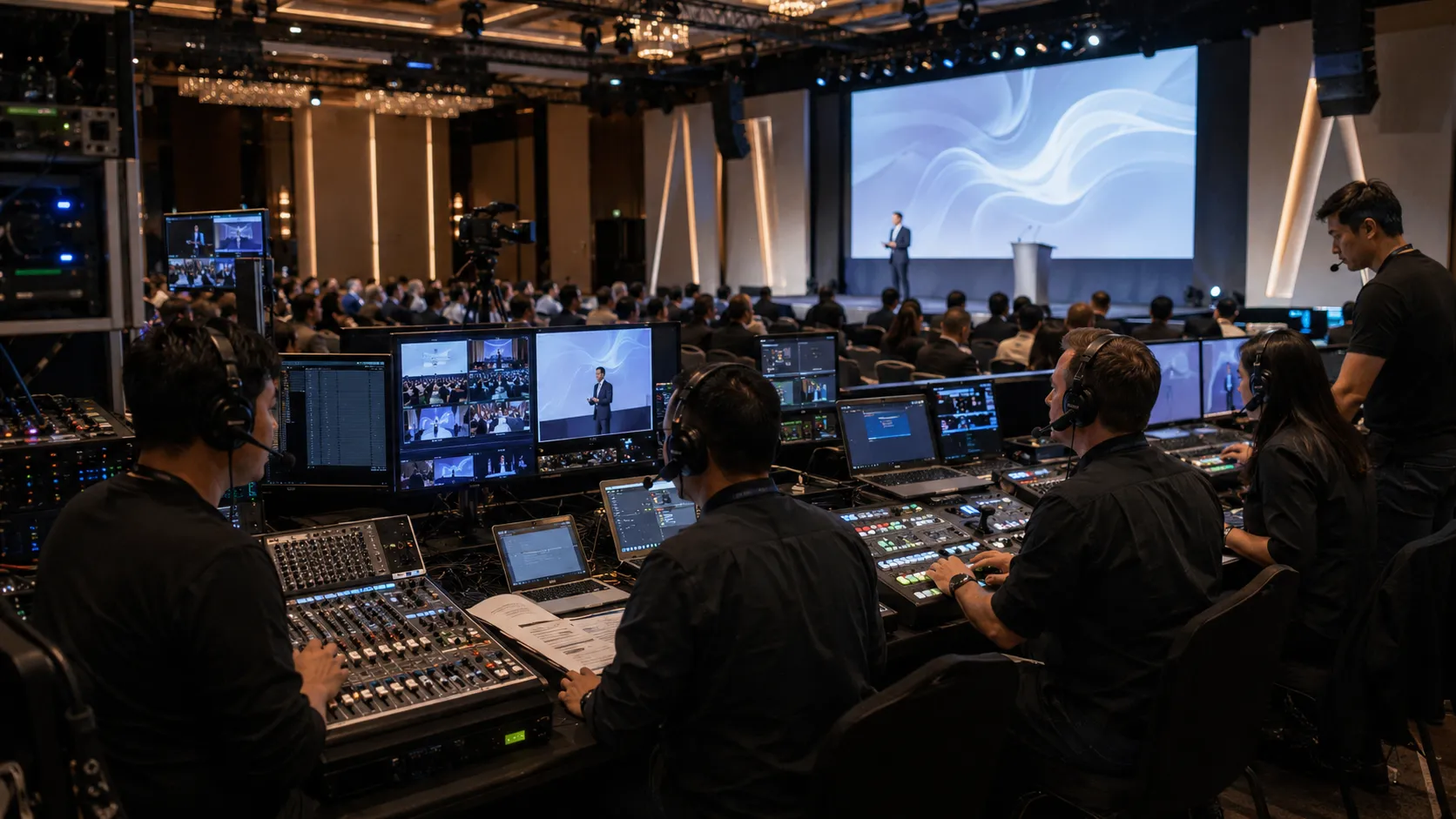
Event Production Services for Conferences: Who Manages What?
One common problem is unclear responsibility between the venue, event agency, production company, corporate client, IT team, and speakers.
Responsibilities should be documented before the event.
| Area | Typical Lead |
|---|---|
| Conference objectives | Corporate client |
| Agenda and content | Corporate client / conference team |
| Venue coordination | Event agency / venue |
| AV specification | Production team |
| Stage design | Production team / event agency |
| Branding | Marketing / creative team |
| Presentation management | Production team |
| Speaker coordination | Event agency / client |
| Technical rehearsals | Production team |
| Show calling | Production or event team |
| Internet requirements | Venue / production / client IT |
| Livestreaming | Production team |
| Event-day logistics | Event agency |
| Technical troubleshooting | Production team |
The exact structure will vary.
The important point is that every responsibility should have a clear owner.
Companies that need one partner to coordinate production alongside venues, suppliers, delegate logistics, branding, and event-day operations can review MICE Makers’ event management services in Singapore or event management services in Malaysia.
How Much Do Conference Event Production Services Cost?
There is no reliable universal price for conference production because the technical scope can vary dramatically.
A quotation may be influenced by:
- Venue
- Event duration
- Setup days
- Rehearsal hours
- Main room size
- Number of breakout rooms
- Audience capacity
- Stage size
- LED requirements
- Projection
- Microphone quantities
- Lighting
- Cameras
- Recording
- Livestreaming
- Rigging
- Internet
- Crew numbers
- Overnight work
- Transport
- Equipment access
- Branding
- Custom fabrication
Instead of asking only, “How much does conference AV cost?”, request an itemized production proposal.
A Useful Production Budget Structure
| Budget Area | What to Review |
|---|---|
| Audio | Speakers, microphones, mixing, technicians |
| Video | Screens, LED walls, projectors, switching |
| Staging | Platforms, steps, lecterns, scenic elements |
| Lighting | Fixtures, control, rigging, technicians |
| Presentation | Laptops, playback, confidence monitors |
| Cameras | Camera operators, switching, recording |
| Streaming | Encoding, platform, internet, technicians |
| Crew | Setup, rehearsal, show hours, dismantling |
| Logistics | Transport, loading, storage |
| Venue charges | Power, rigging, internet, access requirements |
| Contingency | Approved allowance for changes or additional requirements |
Corporate buyers preparing the wider event budget can also use the Corporate Event Cost Calculator and Budget Guide to identify costs beyond technical production.
How Early Should Conference Production Planning Start?
Production planning should begin when the event format, venue options, delegate numbers, and agenda structure are becoming clear.
Do not wait until every presentation is finished.
Early decisions may affect:
- Venue selection
- Stage dimensions
- Seating capacity
- Ceiling and rigging requirements
- Screen positioning
- Camera locations
- Power
- Internet
- Setup time
- Rehearsal time
- Branding
- Budget
Early Planning Stage
Confirm:
- Event objective
- Venue options
- Attendance
- Main agenda
- Breakout requirements
- Production ambition
- Recording or streaming requirements
- Initial budget
After Venue Confirmation
Develop:
- Room layouts
- Stage concept
- Screen requirements
- AV specification
- Lighting design
- Camera plan
- Crew plan
- Technical schedule
Final Weeks
Complete:
- Speaker requirements
- Presentation collection
- Video testing
- Production schedules
- Show flow
- Cue sheets
- Technical contacts
- Rehearsal schedule
- Backup plans
For conferences in Singapore, planners can also review MICE Makers’ conference and exhibition solutions in Singapore. For events in Kuala Lumpur and other Malaysian destinations, see the conference and exhibition solutions in Malaysia.
What Should Event Managers Check Before Hiring a Production Company?
Do not evaluate production suppliers only by the equipment list.
The people, planning process, communication, technical design, and contingency approach matter just as much.
1. Relevant Conference Experience
Ask whether the supplier has delivered events with similar:
- Attendance
- Venue scale
- Agenda complexity
- Breakout rooms
- Executive speakers
- Recording requirements
- Livestreaming
- Stage production
2. Proposed Technical Solution
The supplier should explain why particular equipment is being recommended.
Be cautious if the proposal is simply a long equipment list with little connection to the event brief.
3. Project Team
Confirm who will be responsible for:
- Production management
- Audio
- Video
- Lighting
- Presentations
- Stage management
- Show calling
- Streaming
- On-site communication
4. Venue Coordination
Ask who will confirm:
- Access times
- Loading
- Rigging
- Power
- Internet
- Venue approvals
- Safety requirements
- Dismantling schedules
5. Backup Planning
Ask what happens if:
- A microphone fails
- A laptop crashes
- A video does not play
- Internet connectivity is interrupted
- A remote speaker disconnects
- A presentation arrives late
The answers reveal how thoroughly the event has been planned.
6. Budget Transparency
Compare what is included and excluded.
Check:
- Crew hours
- Setup
- Rehearsals
- Overtime
- Transportation
- Rigging
- Power
- Internet
- Equipment
- Content changes
- Dismantling
The lowest quotation is not necessarily the lowest final cost if important requirements have been excluded.
Common Conference Production Mistakes
Several production problems can be prevented during planning.
Booking Equipment Before Finalizing the Event Format
The agenda should inform the technical solution, not the other way around.
Ignoring Breakout Rooms
Smaller sessions still require reliable presentations and sound.
Leaving Presentations Until the Event Day
Create deadlines and a controlled presentation process.
No Technical Rehearsal
Important speakers and complex sequences should be tested.
Assuming Venue AV Covers Everything
Built-in systems can be useful, but the available infrastructure must be compared with the actual conference brief.
No Clear Production Lead
Someone must coordinate the complete technical plan.
Underestimating Setup Time
Large stages, LED walls, lighting, networking, testing, branding, and rehearsals require venue access before delegates arrive.
No Backup Plan
Critical presentation, audio, video, and connectivity requirements should have appropriate contingencies.
For additional planning issues outside production, see 15 Costly Corporate Event Planning Mistakes and Fixes.
Conference Production in Singapore and Malaysia
Singapore and Malaysia both provide a wide range of hotels, convention centres, meeting spaces, ballrooms, exhibition venues, and specialist event suppliers.
However, production planning should still be venue-specific.
The team should verify:
- Room dimensions
- Ceiling height
- Rigging points
- Loading access
- Setup hours
- Power
- Internet
- Venue AV policies
- Noise restrictions
- Backstage space
- Storage
- Technical control positions
If venue selection has not yet been finalized, the MICE Makers guides to corporate event spaces in Singapore and corporate event spaces in Malaysia can help teams compare different environments before developing the final production specification.
For programs that extend beyond the conference venue and require broader destination logistics, accommodation, transportation, tours, or local ground support, corporate planners may also find this overview of MICE and business tourism in Malaysia useful.
How MICE Makers Supports Conference Production
Conference production works best when technical requirements are coordinated with the complete event plan.
MICE Makers supports corporate conferences and business events in Singapore and Malaysia through event planning, supplier coordination, conference and exhibition solutions, venue coordination, production requirements, staging, AV, guest logistics, and on-site event management.
Depending on the project, support can be structured around the complete conference or around selected workstreams.
A corporate team may already control speakers, content, and branding but require support with:
- Venue coordination
- AV
- Stage production
- Lighting
- Technical suppliers
- Rehearsals
- Event-day operations
Another company may require one partner to coordinate the complete delegate and production experience.
The correct model depends on the client’s internal resources and event complexity.
Planning Conference Production in Singapore or Malaysia?
Prepare the following information before requesting a proposal:
- Destination
- Preferred venue
- Event dates
- Setup dates
- Delegate numbers
- Room layouts
- Main agenda
- Number of speakers
- Breakout sessions
- Stage requirements
- Screens
- Video content
- Recording requirements
- Livestreaming requirements
- Branding
- Entertainment
- Rehearsal requirements
- Budget range
The clearer the brief, the easier it is for a production team to recommend an appropriate technical solution rather than quoting unnecessary equipment.
Final Thoughts
Successful conference production is not about filling a ballroom with the most expensive technology.
It is about choosing the right systems, crew, staging, lighting, presentation workflow, and technical controls for the event objective.
Professional event production services for conferences should help speakers communicate clearly, give delegates a consistent experience, protect the event from avoidable technical problems, and allow the entire program to move smoothly from one session to the next.
Start planning production early, coordinate requirements with the venue, define responsibilities clearly, schedule proper testing and rehearsals, and ask suppliers to explain the reasoning behind their recommendations.
When AV, staging and lighting, presentations, technical crews, venue operations, and event management are planned as one system, production becomes less visible to the audience, which is usually a sign that it is working exactly as intended.
FAQs About Event Production Services for Conferences
What do event production services for conferences include?
Event production services for conferences may include audio, microphones, screens, projection, LED walls, staging, lighting, presentation management, cameras, recording, livestreaming, technical crews, show calling, rehearsals, rigging, internet coordination, and backup systems.
How much do conference event production services cost?
Conference production costs depend on the venue, audience size, number of rooms, equipment requirements, stage design, screens, lighting, cameras, streaming, setup hours, crew, rehearsals, rigging, internet, and event duration. Corporate buyers should request an itemized technical quotation rather than relying on a generic per-person estimate.
How early should conference production planning begin?
Production planning should begin once the event format, venue options, approximate attendance, agenda structure, and technical objectives are known. Complex conferences require additional time for stage design, technical specifications, venue approvals, content preparation, supplier coordination, and rehearsals.
What should event managers check before hiring an event production company?
Check relevant conference experience, proposed technical solutions, project team structure, venue coordination capability, equipment quality, crew coverage, rehearsal process, backup planning, budget transparency, and responsibility for event-day technical control.
What is the difference between conference AV and event production?
Conference AV usually refers to technical equipment and services such as sound, microphones, screens, projection, and video. Event production is broader and may combine AV with staging, lighting, presentation management, show calling, cameras, rehearsals, technical crew management, and overall production control.
Do we need a technical rehearsal for a corporate conference?
A rehearsal is particularly useful when the conference includes senior executives, multiple speakers, important videos, product demonstrations, awards, livestreaming, remote participants, entertainment, or complicated stage transitions.
Can the venue provide all conference AV equipment?
Some venues provide built-in or in-house AV systems, while others work with preferred or external technical suppliers. Organizers should compare the venue’s available infrastructure with the actual production requirements rather than assuming the standard venue package covers the complete event.
Who should manage conference production on the event day?
There should be one clearly identified production lead responsible for coordinating the technical teams. Depending on event complexity, additional roles may include a show caller, stage manager, audio engineer, video operator, lighting operator, presentation technician, camera crew, and streaming technicians.
Can MICE Makers manage conference production in Singapore and Malaysia?
MICE Makers provides conference, exhibition, and event management support in Singapore and Malaysia. The required scope can be structured around technical production only or integrated with wider event planning, venue coordination, suppliers, guest logistics, branding, and on-site event management.
Planning a Conference in Singapore or Malaysia?
Share your event dates, destination, delegate numbers, venue requirements, production scope, and budget range with MICE Makers to start building a coordinated conference plan.
Plan Your Corporate Event