

Destination management services help companies turn an international or out-of-city event brief into a workable local operation.
A regional team may define the business objective, budget, audience, and preferred event format. However, the program still needs to be delivered through local venues, hotels, transport providers, restaurants, guides, production teams, activity suppliers, event staff, and emergency contacts.
A destination management company, commonly called a DMC, acts as the local operational partner connecting these services.
The DMC may help organize conferences, incentive trips, leadership retreats, sales meetings, exhibitions, product launches, awards events, executive visits, and pre-event or post-event programs.
This guide explains what corporate destination management includes, when companies need a local partner, how DMC services are delivered, and how to compare providers in Singapore and Malaysia.
For a broader overview of corporate meetings, events, conferences, and incentive programs, read the MICE Services Guide for Corporate Buyers .
Planning a corporate program in Singapore or Malaysia?
Share your destination, dates, delegate profile, venue, hotel, transportation, activities, dining, production, branding, staffing, VIP requirements, and budget.
Quick Answer: What Are Destination Management Services?
They provide local planning, supplier coordination, logistics, staffing, and on-site support for corporate groups and business events.
A DMC can manage the complete local program or support selected areas such as transport, hotels, activities, venue sourcing, dining, production, or event-day staffing.
What Is a Destination Management Company?
A destination management company is a local specialist that plans and coordinates business events, corporate travel programs, and group experiences within a specific destination.
A DMC should understand:
The company may work directly with the corporate client or support an international agency that needs local delivery capability.
For example, a regional event agency may develop the overall concept and program. The local DMC may then source the venue, arrange transportation, coordinate hotels, appoint guides, manage activities, brief suppliers, and deliver the event on-site.
Destination Management Company vs Event Agency
A destination management company and an event agency may provide overlapping services, but their main strengths can differ.
| Area | Destination Management Company | Event Agency |
|---|---|---|
| Main strength | Local destination operations | Event concept, content, and management |
| Supplier access | Established local network | May work through local partners |
| Transportation | Often a core capability | May outsource locally |
| Hotels | Local sourcing and group coordination | May contract directly or through partners |
| Activities | Destination-specific experiences | May focus more on event programming |
| Production | May coordinate specialist local suppliers | May develop the complete production concept |
| Staffing | Local operational staff | Core team may travel to the destination |
| On-site knowledge | Strong destination familiarity | Depends on market experience |
| Best use | International and out-of-city groups | Events within established operating markets |
Some companies provide both destination management and event agency services.
The name alone does not define capability. Buyers should evaluate the actual scope, team, supplier network, transport experience, production knowledge, and on-site structure.
When Do Companies Need a DMC?
A DMC may also be valuable when an international agency can manage the strategy but does not have local staff, supplier relationships, or destination knowledge.
Corporate Events Supported by a DMC
Meetings and Conferences
- Regional conferences
- Sales meetings
- Dealer meetings
- Association events
- Leadership meetings
Incentive and Group Travel
- Employee incentives
- Partner rewards
- Leadership retreats
- Pre-event tours
- Post-event extensions
Corporate Events
- Product launches
- Exhibitions
- Awards ceremonies
- Client hospitality
- Corporate dinners
The required service scope depends on the event format.
A conference may prioritize venues, registration, technical production, speaker transport, and delegate flow.
An incentive program may place greater emphasis on hotels, private experiences, dining, rooming lists, airport transfers, and participant communication.
An executive visit may require VIP vehicles, privacy, flexible schedules, premium accommodation, and dedicated local support.
1. Destination Research and Recommendation
Destination selection should be based on operational suitability as well as attractiveness.
Matching the Destination to the Objective
Leadership Retreat
May require privacy, premium accommodation, a calm environment, and flexible executive support.
Regional Conference
May require strong air access, a suitable conference venue, efficient group movement, and extensive hotel capacity.
Incentive Program
May prioritize reward value, destination experiences, dining, leisure time, and smooth transportation.
Product Launch
May require a distinctive venue, production access, media support, branding space, and technical flexibility.
A professional DMC should explain why a destination or venue is suitable rather than simply provide a list of popular options.
2. Venue Sourcing and Site Inspections
Venue sourcing involves more than checking availability and capacity.
Business Venues
- Conference hotels
- Convention centres
- Ballrooms
- Meeting rooms
- Exhibition halls
Hospitality Venues
- Restaurants
- Private dining spaces
- Rooftops
- Resorts
- Cultural venues
Experience Venues
- Outdoor locations
- Private attraction spaces
- Waterfront venues
- Heritage locations
- Creative spaces
Venue Evaluation Checklist
Site Inspection Support
A local partner may organize:
- Venue appointments
- Hotel inspections
- Transport between sites
- Technical supplier meetings
- Menu tastings
- Activity inspections
- Route testing
- Venue comparison summaries
- Photography
- Site notes
- Preliminary budgets
Evaluate Operations as Well as Appearance
A venue may look impressive but have limited loading access, insufficient storage, difficult coach access, restricted setup time, or unsuitable backup space.
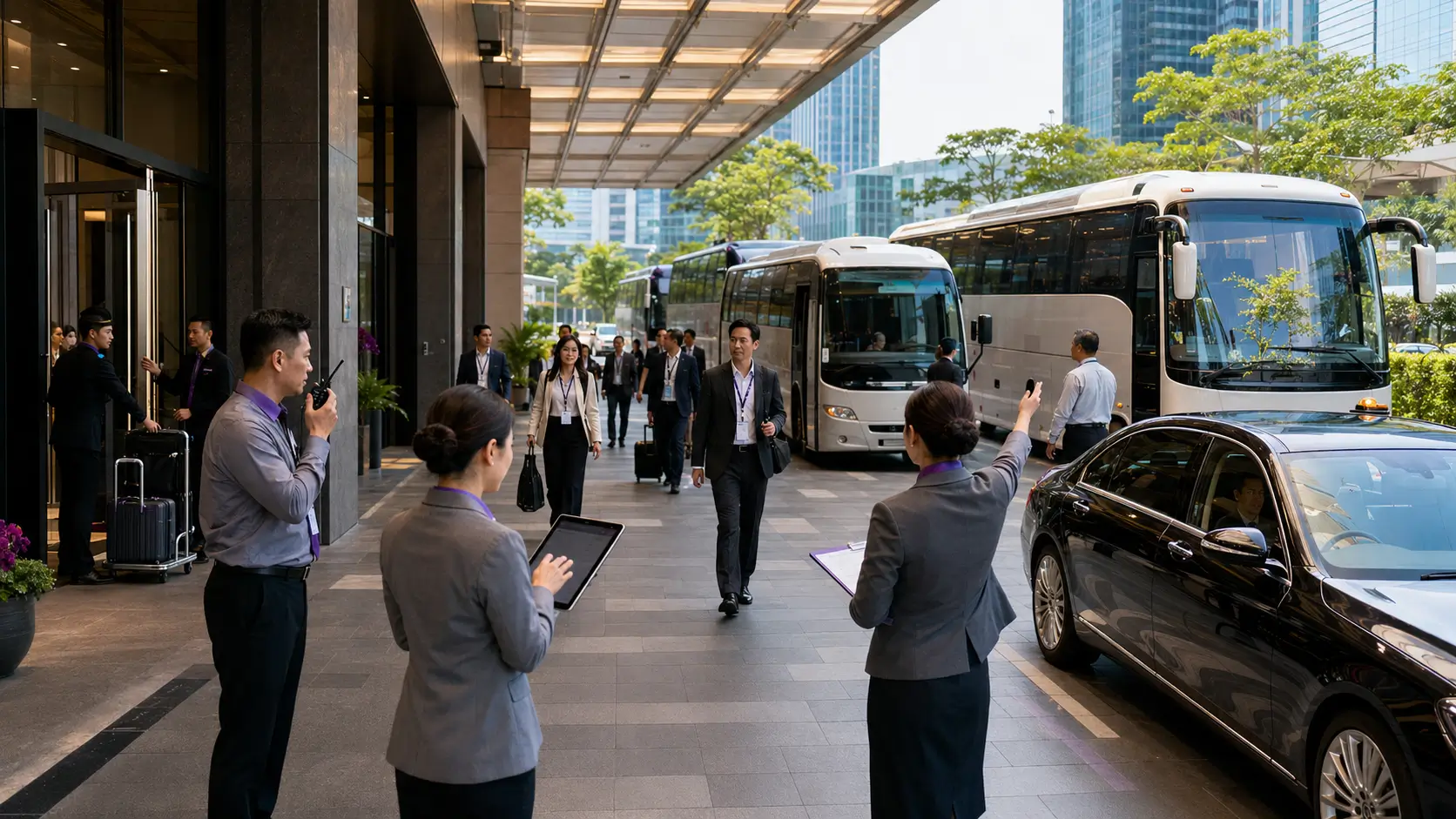
3. Hotel Sourcing and Accommodation Management
Hotel management can become one of the most complex parts of an international corporate event.
Hotel Selection Criteria
- Location
- Distance from the event venue
- Airport access
- Hotel category
- Room quality
- Group check-in capacity
- Breakfast arrangements
- Coach access
- Meeting space
- Hospitality-desk location
- Accessibility
- VIP service
- Security
- Cancellation conditions
Rooming-List Control
One controlled version should be maintained to reduce duplicate bookings, incorrect room types, and billing disputes.
4. Airport Coordination
Airport operations create the first and final impression of the destination.
Arrival Support
- Flight tracking
- Arrival reports
- Meet-and-greet staff
- Welcome signage
- Group assembly
- Luggage coordination
Special Support
- VIP reception
- Delayed-flight support
- Missed connections
- After-hours arrivals
- Emergency contacts
- Hotel updates
Departure Support
- Departure reports
- Hotel dispatch
- Airport transfers
- Check-in guidance
- Luggage coordination
- Final passenger checks
Vehicle Dispatch
- Vehicle allocation
- Driver coordination
- Waiting-time control
- VIP vehicle assignment
- Late-arrival vehicles
- Backup transport
Arrival Planning
| Requirement | Details |
|---|---|
| Flight number | Confirmed airline and flight |
| Arrival time | Scheduled and updated arrival time |
| Terminal | Correct arrival terminal |
| Passenger count | Confirmed number on the flight |
| VIP status | Special handling or separate transport |
| Meeting point | Airport location for guest assembly |
| Coordinator | Responsible airport staff member |
| Assigned vehicle | Coach, minibus, sedan, or VIP vehicle |
| Hotel destination | Confirmed drop-off point |
| Delay procedure | Communication and reassignment process |
5. Ground Transportation
Corporate event transport requires accurate timing, suitable vehicles, and clear ownership.
Transport Planning Requirements
- Passenger numbers
- Vehicle capacity
- Luggage capacity
- Pickup locations
- Drop-off locations
- Traffic allowances
- Parking
- Loading restrictions
- Driver contact details
- Vehicle signage
- VIP requirements
- Backup vehicles
- Waiting time
- Overtime
Master Movement Schedule
| Requirement | Details |
|---|---|
| Date | Day of movement |
| Pickup time | Scheduled departure time |
| Pickup location | Hotel, airport, venue, or activity site |
| Destination | Final drop-off point |
| Vehicle | Coach, minibus, sedan, van, boat, or ferry |
| Passenger group | Delegates, speakers, VIPs, staff, or guests |
| Driver | Name and contact details |
| Coordinator | Responsible local team member |
| Luggage | Quantity and special handling |
| Backup plan | Alternative vehicle, driver, or route |
Transport timing should include boarding, luggage handling, walking distance, traffic, security checks, and group delays.
6. Activities and Destination Experiences
Activities should reflect the audience, objective, destination, schedule, and available budget.
Possible Experiences
Culture and Food
- Cultural tours
- Culinary programs
- Creative workshops
- Heritage experiences
Nature and Leisure
- Harbour experiences
- Island activities
- Nature programs
- Wellness sessions
Corporate Experiences
- Team challenges
- Private attraction access
- Community engagement
- Leadership activities
Activity Planning Questions
- Is participation compulsory?
- Is an alternative activity available?
- Are waivers required?
- Are there health restrictions?
- Is insurance included?
- Is special clothing required?
- Is equipment provided?
- What happens in bad weather?
- How long is the transfer?
- Is the activity suitable for VIPs or senior participants?
Explore team-building activities in Singapore and team-building activities in Malaysia .
7. Dining and Private Events
Dining is often central to corporate hospitality, networking, recognition, and destination experience.
Possible Functions
- Welcome dinners
- Networking receptions
- Executive dinners
- Client dinners
- Gala dinners
- Awards nights
Venue Styles
- Rooftop events
- Resort dinners
- Cultural dining
- Private restaurants
- Waterfront venues
- Farewell receptions
Dining Requirements
Choose Corporate Dining Venues Carefully
The most visually impressive restaurant may not always be the best corporate option. Coach access, private-room capacity, service speed, menu flexibility, sound restrictions, accessibility, and speech requirements must also be reviewed.
8. Conference and Meeting Logistics
Corporate destination management may include complete conference logistics or selected local services.
Delegate Flow
The DMC should consider how participants move between:
- Airport and hotel
- Hotel and venue
- Registration and main hall
- Main hall and breakout rooms
- Sessions and catering
- Exhibition and conference areas
- Venue and dinner location
- Conference and departure transport
Poor movement planning can create late starts, queues, missed sessions, overcrowding, and transport delays.
For conference-specific supplier evaluation, read the Conference Management Company Selection Guide .
9. Event Production and Technical Coordination
Some DMCs manage production through an internal team. Others appoint specialist local suppliers.
Production Responsibilities
- Technical design
- Equipment quotation
- Venue approvals
- Power requirements
- Rigging
- Setup
- Content testing
- Speaker rehearsals
- Show calling
- Stage management
- Recording
- Dismantling
- Equipment backup
Production Supplier Evaluation
The proposal should state clearly which production services are included and which are provided by subcontractors.
10. Branding and Event Materials
Destination-Sensitive Branding
Branding should consider:
- Venue rules
- Airport restrictions
- Transport regulations
- Local cultural expectations
- Public-space limitations
- Installation time
- Removal requirements
- Weather
- Sustainability
- Participant privacy
Branding should support the guest journey without becoming excessive or difficult to manage.
11. Local Staffing
A DMC provides people as well as suppliers.
Staffing Plan
- Number of staff
- Roles
- Working hours
- Reporting lines
- Languages
- Uniform
- Communication equipment
- Overtime
- Replacement process
- Emergency availability
Briefing Local Staff
12. Supplier Sourcing and Management
A DMC may coordinate many local suppliers through one project structure.
Identify Suitable Suppliers
Shortlist suppliers according to destination knowledge, availability, service quality, experience, and budget.
Request and Compare Quotations
Review rates, inclusions, exclusions, availability, payment terms, and cancellation conditions.
Negotiate and Confirm
Agree the scope, pricing, service standards, deposits, deadlines, and backup requirements.
Brief and Coordinate
Share the schedule, audience profile, venue details, operational responsibilities, and reporting lines.
Manage Changes
Track revisions, participant changes, supplier updates, cost effects, and client approvals.
Reconcile Final Costs
Confirm final quantities, additional charges, refunds, deposits, and supplier invoices.
Supplier Categories
Travel and Hospitality
- Hotels
- Venues
- Transport companies
- Restaurants
- Guides
Events and Production
- Production companies
- Printers
- Staffing agencies
- Entertainment providers
- Security companies
Participant Support
- Activity operators
- Medical support
- Photographers
- Videographers
- Specialist suppliers
Supplier Responsibility Matrix
| Area | Information to Record |
|---|---|
| Supplier | Confirmed company and main contact |
| Scope | Exact service or product responsibility |
| Client contact | Responsible approval contact |
| DMC contact | Local project owner |
| Deadline | Submission, setup, or delivery date |
| Payment | Deposit and final payment requirements |
| Cancellation | Cancellation and reduction terms |
| Backup | Alternative supplier or contingency option |
| Approval status | Pending, approved, confirmed, or completed |
13. Local Knowledge and Cultural Considerations
Local knowledge helps international organizers avoid unnecessary operational problems.
Scheduling Considerations
- Public holidays
- School holidays
- Major conferences
- Festivals
- Religious periods
- Sporting events
- Peak travel seasons
- Weather conditions
- Road closures
Food and Hospitality
Local support may be needed to coordinate:
- Halal requirements
- Vegetarian and vegan options
- Religious dietary needs
- Food allergies
- Alcohol policies
- VIP dining expectations
- International and local menu balance
14. Risk and Contingency Planning
Every destination program should include practical backup plans.
Travel Risks
- Flight delays
- Flight cancellations
- Lost luggage
- Passport problems
- Late arrivals
Event Risks
- Venue issues
- Technical failure
- Supplier cancellation
- Low attendance
- Schedule changes
Destination Risks
- Bad weather
- Traffic disruption
- Activity cancellation
- Medical incidents
- Security concerns
Risk Register
Examples of Contingency Planning
- Alternative indoor activity
- Backup vehicle
- Secondary transport route
- Replacement guide
- Alternative restaurant
- Spare technical equipment
- Additional airport staff
- Emergency medical contact
- Updated guest communication template
- Flexible VIP schedule
Professional Risk Planning Is Realistic
A suitable DMC should identify realistic risks and practical responses rather than promise that no problems will occur.
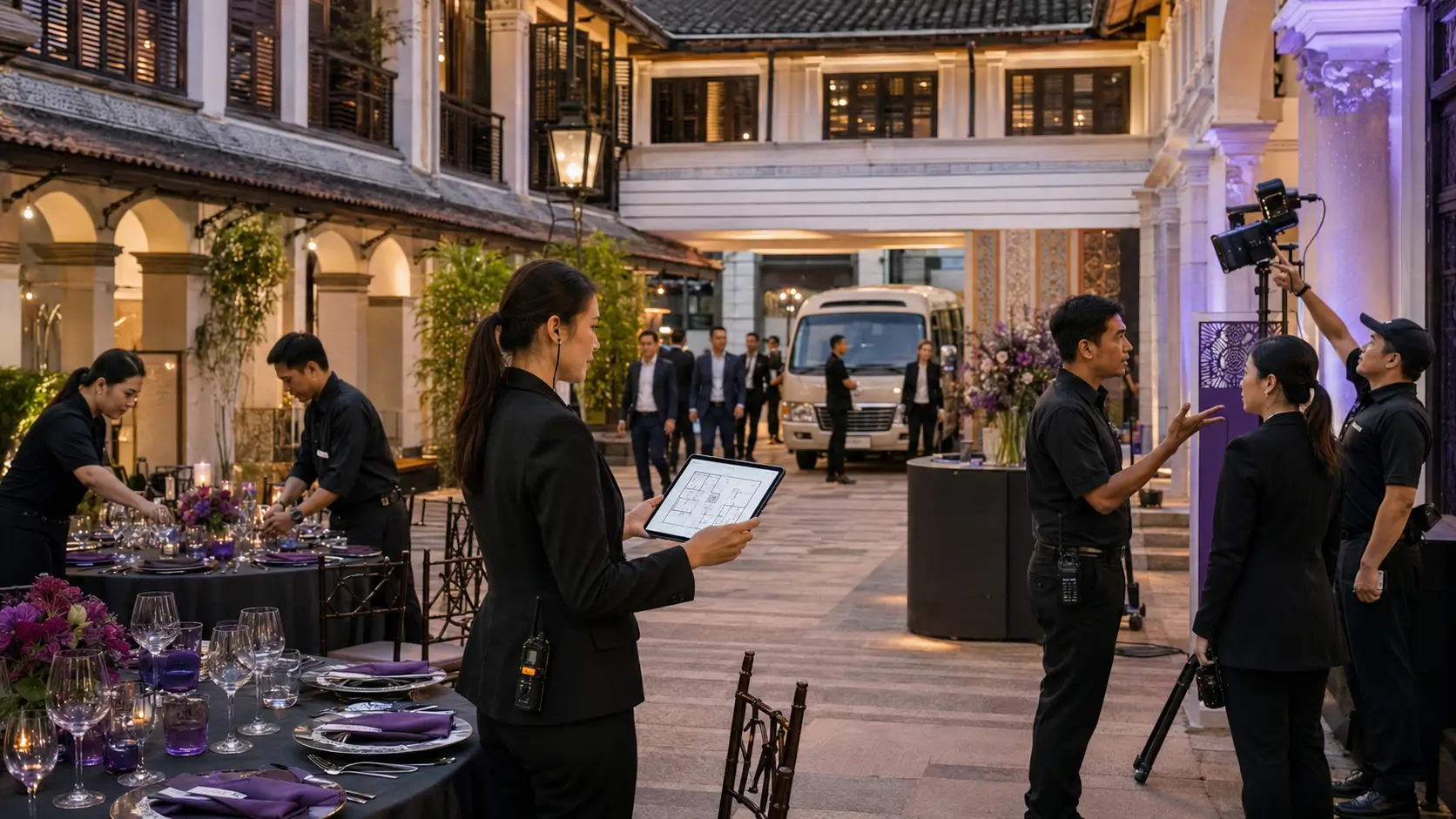
15. On-Site Command Structure
A clear command structure is essential when several suppliers, venues, hotels, and transport providers are involved.
On-Site Communication
- Main communication channel
- Staff contact list
- Supplier contact list
- Escalation process
- Approval limits
- Emergency phone
- Daily briefing time
- Incident reporting process
- Schedule-change procedure
Daily Briefings
16. Destination Management Services in Singapore
Singapore can support compact, premium, and operationally efficient corporate programs.
Suitable Program Types
- Regional conferences
- Executive visits
- Leadership meetings
- Sales events
- Partner programs
- Incentive trips
- Client hospitality
- Product launches
Corporate Advantages
- Strong international access
- Compact group movement
- Premium hotels
- Convention facilities
- Modern event venues
- International dining
- Business infrastructure
- Efficient airport transfers
Possible Singapore Services
Review destination management in Singapore for location-specific support.
17. Destination Management Services in Malaysia
Malaysia can support city, resort, island, cultural, nature, and multi-destination programs.
Kuala Lumpur
- Conferences
- Product launches
- Regional meetings
- Dealer events
- Executive programs
- Awards dinners
Langkawi
- Resort incentives
- Leadership retreats
- Island activities
- Private dinners
- Team experiences
- Nature programs
Penang
- Cultural programs
- Culinary experiences
- Heritage events
- Corporate retreats
- Regional meetings
- Creative activities
Malacca
- Cultural extensions
- Leadership groups
- Heritage dining
- Short corporate programs
- Regional road itineraries
- Historic venues
Kota Kinabalu
- Nature programs
- Resort incentives
- Island activities
- Adventure experiences
- Executive retreats
- Premium dining
Combined Programs
- City and resort combinations
- Nature and culture itineraries
- Multi-hotel programs
- Domestic flight coordination
- Ferry and road transfers
- Pre-event and post-event extensions
Malaysia can support city and resort combinations, but domestic flights, road transfers, ferries, luggage movement, and travel time must be planned carefully.
Review destination management in Malaysia for local program support.
18. Singapore or Malaysia for a Corporate Event
The right destination depends on travel access, group profile, budget, event style, and program length.
| Evaluation Area | Singapore | Malaysia |
|---|---|---|
| International access | Strong international and regional connectivity | Strong regional and international options |
| Group movement | Compact and generally efficient | Depends on the selected destination |
| Event style | Premium urban and modern | Urban, resort, cultural, island, and nature |
| Budget range | Generally positioned toward premium city programs | Wider range of options |
| Multi-destination programs | More limited | Strong domestic variety |
| Resort options | More limited | Broad range |
| Short business programs | Strong | Strong in major cities |
| Incentive extensions | City, harbour, and island-style activities | City, island, resort, nature, and culture |
Singapore may be suitable for a compact premium program with efficient movement.
Malaysia may suit companies seeking a wider range of destinations, resort programs, nature experiences, cultural itineraries, or greater budget flexibility.
A combined Singapore and Malaysia itinerary may work for longer programs, but border procedures, flight timing, luggage, and additional transfers must be included.
19. What Information Should You Give a DMC?
A clear brief helps the DMC prepare an accurate proposal.
Scope Responsibilities
State which services will remain with the internal team and which services the DMC should manage.
| Service | Internal Team | DMC |
|---|---|---|
| Event strategy | Lead | Support |
| Venue sourcing | Approval | Lead |
| Hotel contracting | Approval | Lead |
| Delegate registration | Lead or shared | Support or lead |
| Airport transfers | Oversight | Lead |
| Activities | Approval | Lead |
| Production | Approval | Lead or coordinate |
| On-site staffing | Oversight | Lead |
| Final reporting | Review | Prepare |
20. How to Compare Destination Management Companies
Do not compare providers only by total price.
Relevant Experience
Ask for examples involving:
- A similar group size
- A similar destination
- A similar event type
- International delegates
- Complex airport arrivals
- Multiple hotels
- VIPs
- Conferences
- Incentive travel
- Production
- Several local suppliers
The most relevant example is not necessarily the largest project. It is the one with the most similar operational requirements.
Budget Transparency
For broader supplier evaluation, read How to Choose a MICE Agency in Singapore or Malaysia .
21. Questions to Ask a DMC
- How long have you operated in the destination?
- Which services do you manage directly?
- Which services are subcontracted?
- Who will manage our project?
- Who will work on-site?
- How do you select suppliers?
- How do you control supplier quality?
- How do you manage transport?
- How do you handle delayed flights?
- How do you coordinate hotels?
- How do you manage VIP guests?
- How do you handle last-minute changes?
- What backup plans do you recommend?
- How are costs presented?
- What is included in the management fee?
- What is excluded?
- Can you provide relevant case studies?
- Can you provide client references?
- What reports will be provided?
- Who is available outside normal working hours?
22. Warning Signs
Be Cautious When the DMC:
- Provides generic destination ideas
- Does not understand the audience
- Gives unclear pricing
- Cannot explain supplier responsibilities
- Has no detailed transport plan
- Does not assign a project manager
- Avoids discussing risks
- Has limited local staffing
- Cannot provide relevant examples
- Responds slowly or inconsistently
- Leaves important services undefined
- Does not explain exclusions
- Cannot provide an escalation process
- Has no clear on-site structure
One issue may be manageable. Several warning signs may indicate future operational difficulty.
23. Destination Management Budget Categories
A DMC proposal should separate the main local cost areas.
| Cost Category | Typical Items |
|---|---|
| Hotels | Rooms, breakfast, taxes, upgrades, and porterage |
| Transport | Airport transfers, coaches, VIP vehicles, and luggage vans |
| Venues | Rental, setup, security, storage, and overtime |
| Activities | Tickets, guides, equipment, private access, and insurance |
| Dining | Meals, beverages, private venues, entertainment, and staffing |
| Production | Sound, lighting, stage, screens, equipment, and crew |
| Staffing | Coordinators, guides, registration staff, runners, and overtime |
| Branding | Signage, badges, gifts, printing, and transport branding |
| Management fees | Planning, supplier coordination, documentation, and on-site delivery |
| Contingency | Delays, changes, replacements, and emergency costs |
The proposal should also explain:
The Corporate Event Cost Calculator can help identify commonly missed budget areas.
24. Destination Management Planning Timeline
The planning timeline depends on group size, destination, venue availability, flights, hotels, activities, production, and internal approvals.
9 to 12 Months Before
- Confirm the event objective
- Set the initial budget
- Estimate delegate numbers
- Shortlist destinations
- Review flight access
- Request DMC proposals
- Review visa practicality
- Check venue and hotel availability
6 to 9 Months Before
- Appoint the DMC
- Confirm the destination
- Source venues
- Secure hotel blocks
- Develop the program
- Review transport requirements
- Confirm major suppliers
- Begin risk planning
3 to 6 Months Before
- Confirm transportation
- Finalize activities
- Plan dining
- Appoint production suppliers
- Develop branding
- Prepare participant communication
- Confirm staffing
- Update the budget
1 to 3 Months Before
- Finalize rooming lists
- Confirm flight manifests
- Complete movement schedules
- Brief suppliers
- Confirm VIP requirements
- Review dietary and accessibility needs
- Complete risk plans
- Prepare on-site documents
Final Weeks
- Reconfirm every supplier
- Confirm final participant numbers
- Issue joining information
- Complete staff briefings
- Reconfirm emergency contacts
- Test production
- Review transport dispatch
- Prepare daily briefing documents
After the Event
- Reconcile costs
- Review supplier performance
- Collect feedback
- Complete incident reports
- Prepare final attendance information
- Submit the operational report
- Record lessons learned
Destination management services should continue through final reconciliation and reporting, not end when the last participant departs.
How MiceMakers Supports Destination Management
MiceMakers can support companies, associations, conference organizers, incentive groups, and international agencies with complete or selected local services.
The service scope can be adjusted according to the client’s internal resources.
Some companies require complete local management. Others need support only with airport transfers, hotels, activities, dining, production, or on-site staffing.
MiceMakers also provides event management services in Singapore and event management services in Malaysia .
Plan your corporate event with a local destination partner
Submit your destination, dates, delegate profile, venue, hotels, transport, activities, dining, production, branding, staffing, VIP requirements, and budget.
Final Thoughts
Destination management services connect an international event brief with the local people, places, suppliers, schedules, and operational details needed to deliver it successfully.
A strong DMC should provide more than venue suggestions and transport quotations.
It should understand the event objective, recommend suitable local options, coordinate suppliers, control movement, manage participants, prepare backup plans, assign an experienced local team, and provide clear budget and reporting structures.
Corporate buyers should compare destination knowledge, relevant experience, supplier capability, transport planning, hotel expertise, staffing, communication, risk controls, and cost transparency.
The right local partner reduces uncertainty, improves accountability, and allows the internal or international planning team to focus on the business objective while the destination operation is managed professionally.
Ready to build a local corporate event program?
Share your requirements with MiceMakers and begin developing a structured program for Singapore or Malaysia.
FAQs About Destination Management
What are destination management services?
Destination management services provide local planning, supplier coordination, transport, hotels, venues, activities, dining, staffing, production, risk planning, and on-site support for corporate events and group travel programs.
What is a destination management company?
A destination management company is a local specialist that coordinates venues, hotels, transportation, activities, suppliers, staffing, and event logistics within a particular destination.
What does DMC mean in corporate events?
DMC means destination management company. It usually refers to a local business that supports conferences, incentives, meetings, exhibitions, executive visits, and other corporate groups.
What is the difference between a DMC and an event agency?
A DMC usually specializes in local destination operations, transport, hotels, activities, and supplier coordination. An event agency may focus more on concept, content, production, and overall project management. Some companies provide both.
When should a company hire a DMC?
A DMC is useful when the program includes international delegates, an unfamiliar destination, group transport, multiple hotels, VIPs, several venues, local suppliers, activities, dining, or complex on-site logistics.
What information should be included in a DMC brief?
Include the objective, destination, dates, delegate profile, venues, hotels, arrival and departure details, transport, activities, dining, production, branding, staffing, VIP needs, accessibility, budget, and proposal timeline.
How should DMC proposals be compared?
Compare destination experience, supplier network, transport capability, hotel knowledge, staffing, production coordination, risk planning, communication, references, budget transparency, and on-site support.
Can a DMC manage airport transfers?
Yes. A DMC may manage flight tracking, meet-and-greet staff, group assembly, luggage coordination, vehicle dispatch, VIP arrivals, delayed flights, and departure support.
Can a DMC manage event production?
Some DMCs manage production directly, while others appoint specialist production companies. The proposal should explain which services are internal and which are subcontracted.
How can MiceMakers support destination management?
MiceMakers can support destination consultation, venues, hotels, airport coordination, transport, activities, dining, production, branding, registration, staffing, VIP services, supplier management, risk planning, on-site delivery, and reporting in Singapore and Malaysia.